GOVERNANCE STANDARD v1.0 · PATIENTCENTRICCARE.AI
Hybrid Human–Agent Operating Standard
Defines who decides, when AI can act, and how every decision is governed at runtime.
Why this matters
- AI is scaling faster than governance
- Decisions are happening without defined authority
- Most systems rely on retrospective audit, not real-time control
This standard enforces human authority before AI acts — not after.
Human Authority Line
Safety OS enforces a clear authority boundary — every AI action is classified into one of three governance tiers.
Defines who decides, when AI can act, and how every action is accountable.
Human Required / AI Blocked
AI blocked. Human authority is mandatory. Execution only by designated authority.
Decision Source: Human only
Audit: Immutable, traceable, attributableAI Recommends / Human Confirms
AI may propose actions. Execution requires explicit human confirmation before proceeding.
Decision Source: AI → Human confirmation
Escalation triggered if thresholds exceeded
Audit: Immutable, traceable, attributableAI Executes Within Bounds
AI operates autonomously within pre-defined, auditable boundaries. Human oversight remains upstream.
Decision Source: AI (bounded)
Audit: Immutable, traceable, attributableEvery action is classified and logged at runtime with decision source, authority level, and outcome.
How it works at runtime
Runtime Control Architecture
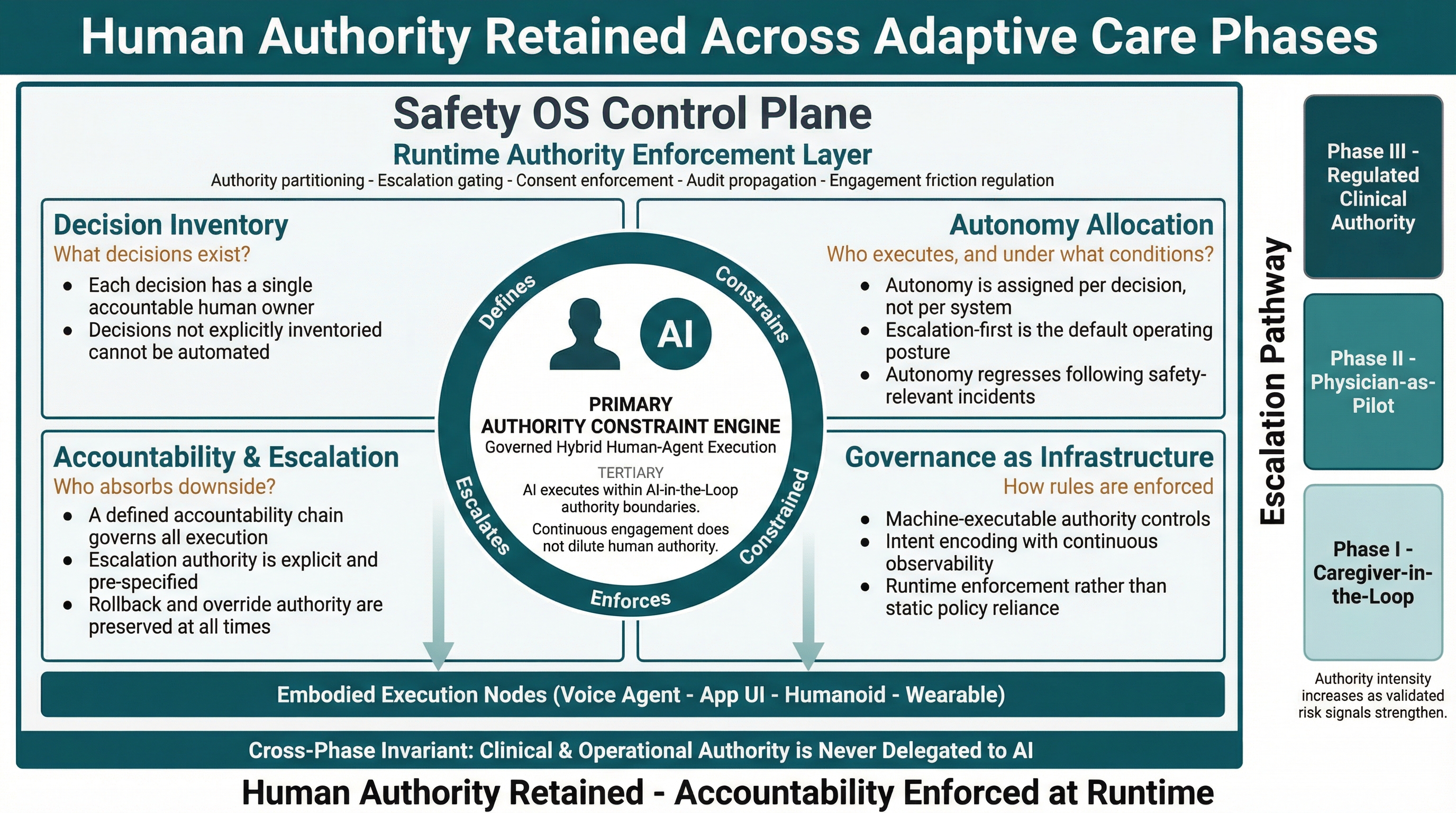
Illustrative governance architecture: maps authority, enforcement, and escalation across deployment contexts. Does not imply commercial readiness, autonomous clinical action, or regulatory approval.
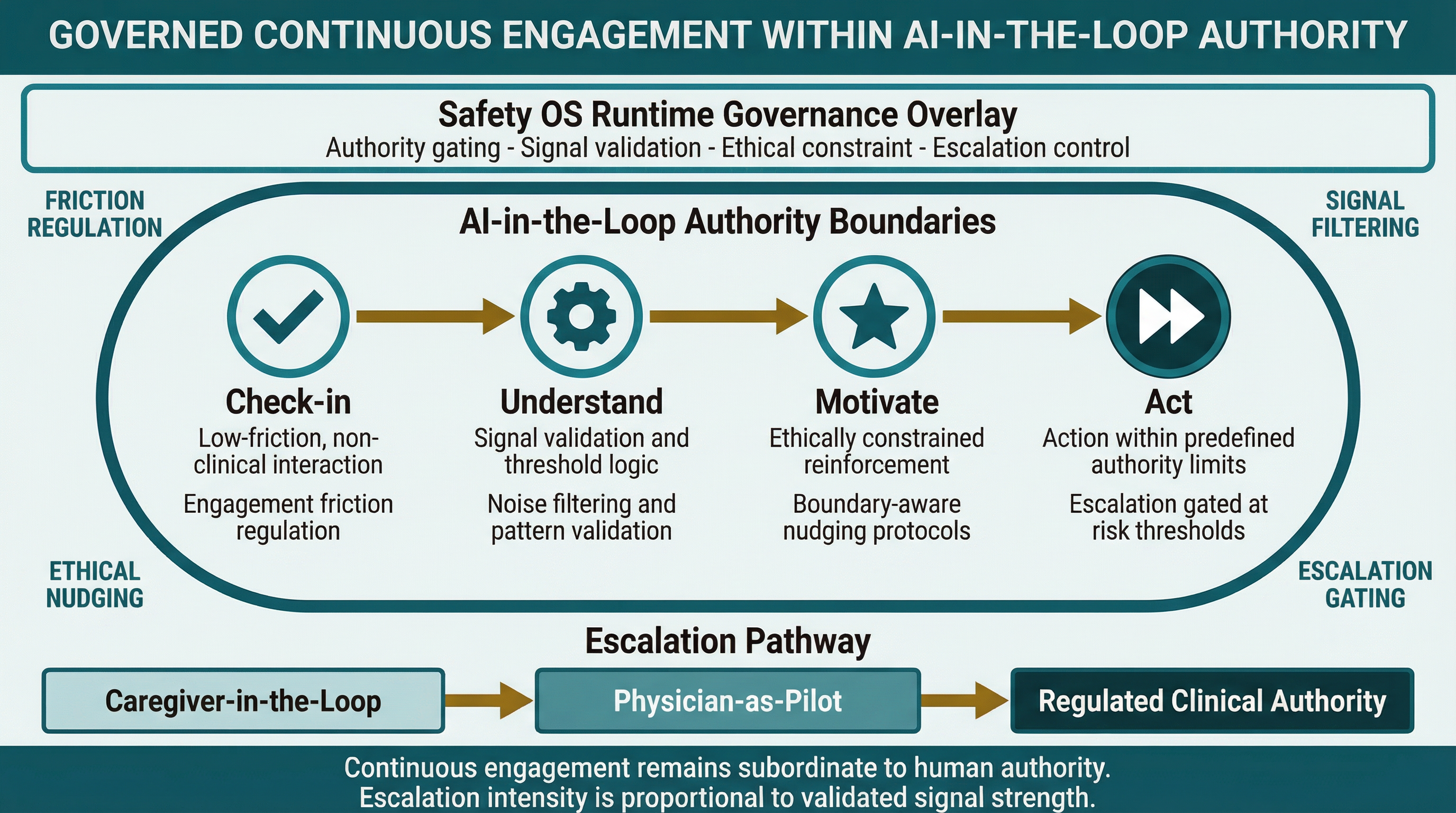
Continuous engagement operates within preserved human authority. Escalation intensity is proportional to validated signal strength.
Core Architectural Principles
Five enforceable invariants:
1 Explicit Authority Partitioning
Humans retain binding authority; agents execute within defined permissions.
2 Bounded Autonomy
Every capability has an assigned autonomy level. Unclassified capabilities cannot execute.
3 Deterministic Escalation
Escalation logic is pre-defined, auditable, and irreversible until resolved.
4 Consent Lifecycle Enforcement
Active consent is tracked, enforced, and timestamped for every interaction.
5 Immutable Auditability
All decisions and escalations are logged with immutable, traceable, attributable audit logging.
What this is NOT
- × Not a policy framework
- × Not post-hoc audit
- × Not model governance
- × Not a monitoring layer
What this IS
- ✓ Runtime control plane
- ✓ Authority enforcement layer
- ✓ Deterministic escalation system
- ✓ Auditable decision infrastructure
Example: Calling a caregiver
Control Plane vs. Embodied Agents
Safety OS is a control plane — not an interface.
Embodiments (voice agent, app UI, humanoid robot, wearable) are execution nodes. The control plane is the source of truth for:
- Identity & consent context
- Role-based capability activation
- Escalation gating & runtime enforcement
Agents are execution enforcers — the Control Plane is the governance engine.
Safety OS Progression Model
Staged adoption for regulated deployment:
Phase I — Caregiver-in-the-Loop
- Non-clinical workflows
- Caregiver escalation validated
- Identity, consent, escalation gating tested
Phase II — Physician-as-Pilot
- Clinical workflows with human final authority
- Agent execution scoped and reversible
Phase III — AIaMD / SaMD-Aligned
- MDR / FDA / EU AI Act alignment
- Physician authority remains upstream
- Safety OS ensures regulatory continuity
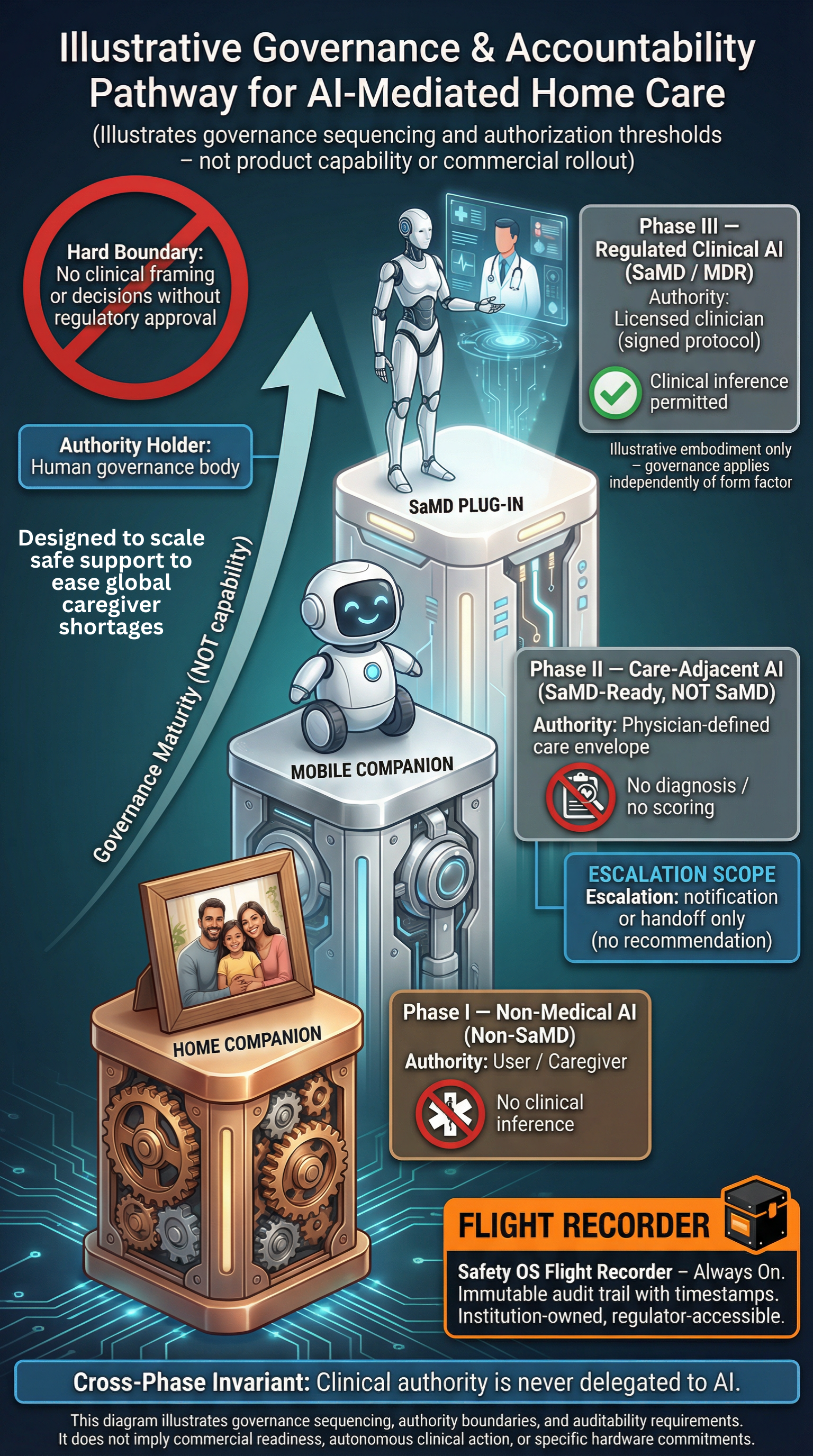
Governance Compatibility
Safety OS complements existing governance frameworks:
| Framework | Alignment |
|---|---|
| EU AI Act | High-Risk AI requirements |
| NIST AI RMF | AI Risk Management Framework |
| OECD AI Principles | Trustworthy AI principles |
| ISO/IEC 42001 | AI Management System |
Alignment context only. Does not imply regulatory clearance.
Downloads & Governance Artifacts
Every AI system already operates somewhere on the Human Authority Line.
The question is whether you designed it — or it emerged by default.
Reference & License
v2.0 - stable
Published by PatientCentricCare.AI. Safety OS reference model and control plane implementation are proprietary. Public doctrine and reference models are provided for citation, research, and standard-building with attribution. View license.
How to cite
Squire, A. (2026). Safety OS™ — A Human-Agent Teaming Control Architecture (v2.0). PatientCentricCare.AI. https://www.patientcentriccare.ai/standards/hybrid-human-agent-operating-standard