Selected as Best Overall Capstone
Harvard Medical School Executive Education, "AI in Healthcare," February 2026
Clinical AI Governance
Authority, Boundaries, Enforcement, Auditability
Clinical AI governance is not about model intelligence - it's about who is authorized to act, when, and under what constraints.
This framework defines how execution is governed at runtime, how boundaries are enforced, and how accountability is provable before clinical claims are made.
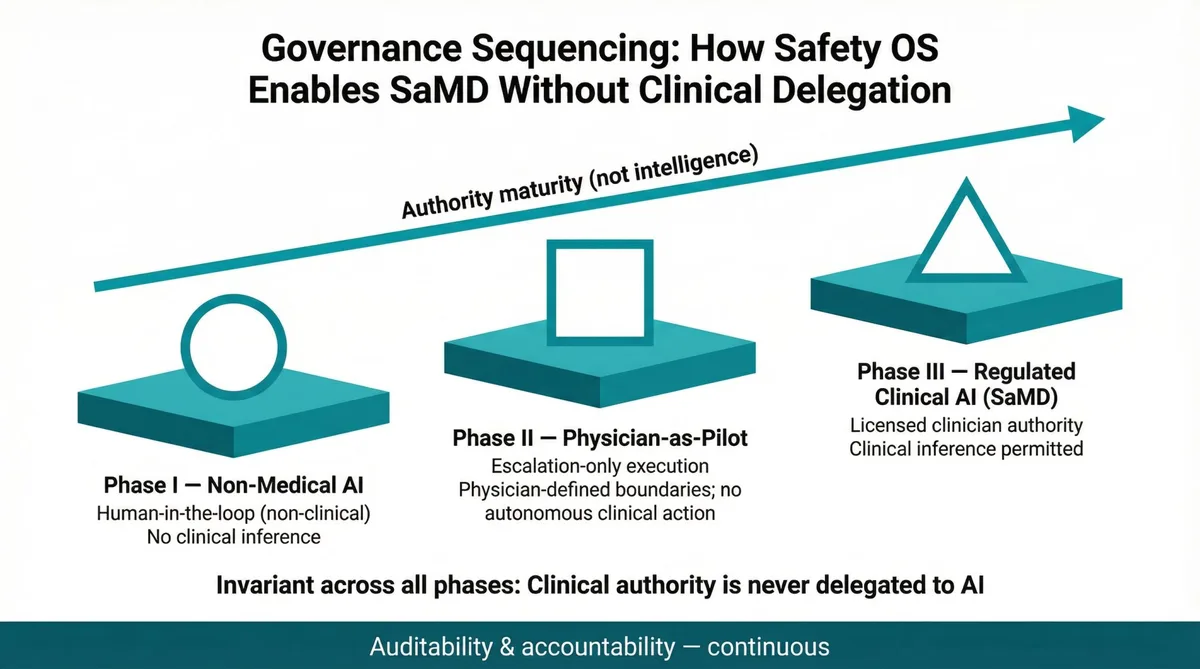
Governance applies across all phases of AI deployment - from non-medical to SaMD readiness and regulated clinical AI.
For a high-level view of how authority is phased and matured, see the Governance Roadmap.
Safety OS Governance Architecture. This conceptual diagram illustrates how a governance layer enforces boundaries, constrains actions, and generates immutable audit evidence under continuous human oversight. This is architecture - not a product or clinical claim.
Regulatory Alignment
| Governance Capability |
Regulatory Relevance |
| Authority Inventory |
Clinical evaluation alignment |
| Runtime Enforcement |
Supports QMS and traceability |
| Auditability |
Post-market surveillance & PMS |
| Permission Constraints |
SaMD risk management expectations |
References to FDA/MDR are descriptive; they do not imply clearance or endorsement.
In Practice
This governance model ensures:
- Named authority for every potential clinical action
- Boundaries enforced deterministically at execution time
- Escalation to human authority only
- Immutable evidence suitable for regulatory review
The Clinical Boundary ("Hand-Off Threshold")
Clinical inference is not permitted in Phase I. The threshold for diagnostic or therapeutic output is gated behind regulatory authorization and physician-supervised workflows in subsequent phases.
AI Act Alignment
Phase I logging architecture aligns with traceability principles under AI Act Article 12 (record-keeping and technical documentation).
This does not constitute a compliance claim. "Aligned with" indicates architectural intent, not certified conformity.
EU MDR Scope
Phase I is designed to operate outside the scope of EU MDR (2017/745) by explicitly excluding medical intent, diagnosis, and therapeutic recommendation.