Harvard Medical School Executive Education, "AI in Healthcare," February 2026
HCP-as-Pilot™ v3.5, Updated June 2026 — now with Runtime Governance Infrastructure (RGI)Read the Paper →
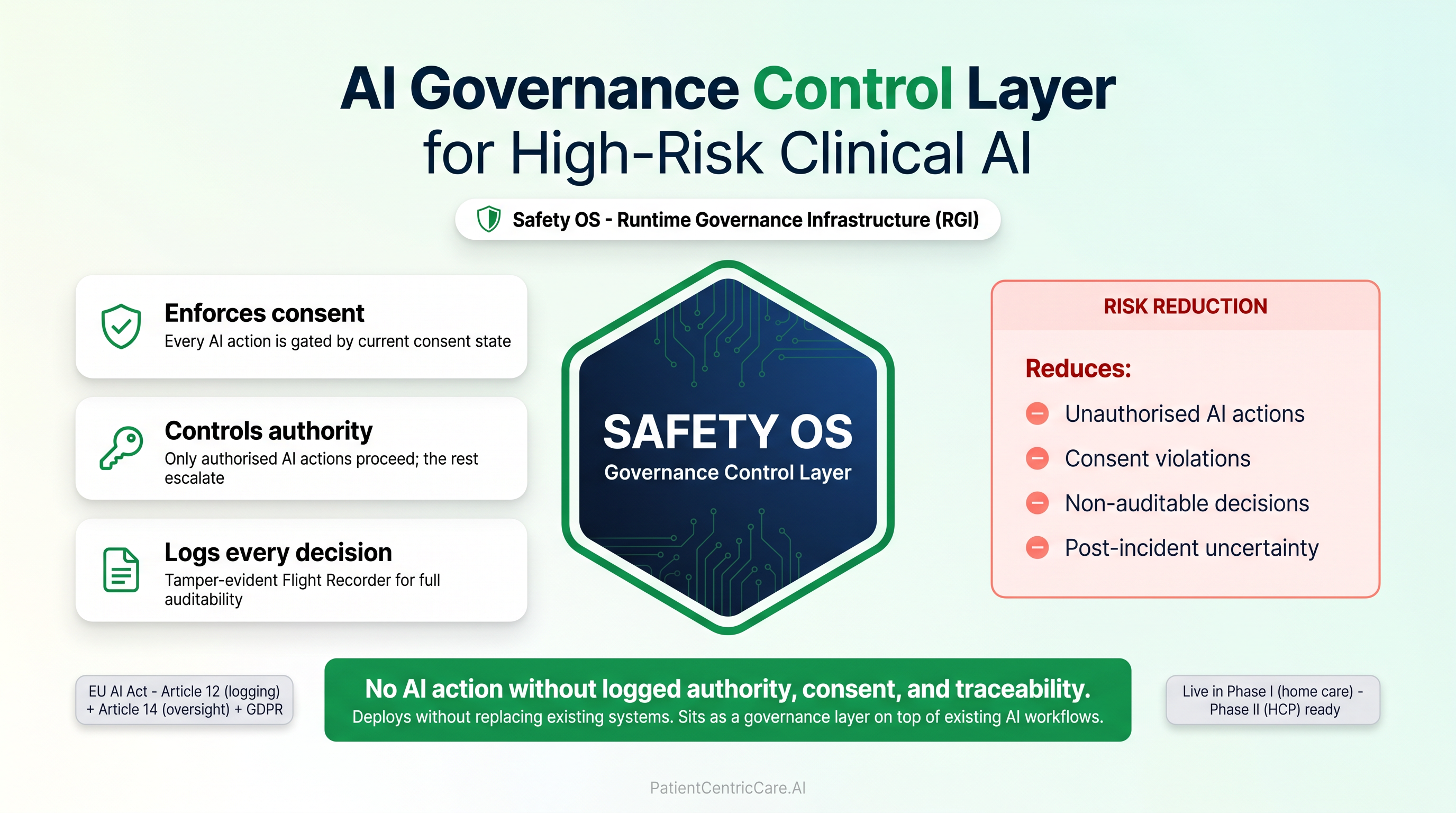
Safety OS™ — Runtime Governance Infrastructure for healthcare AI.
The control plane between AI output and patient-impacting action.
Enforces consent, authority, and audit before every AI action executes.
✓AI never acts without authorisation
✓Every action logged and auditable
✓Automatic escalation to clinicians
AI Governance Control Layer
Tightly-bounded Agentic Orchestration enables a Safe Continuum of Care.
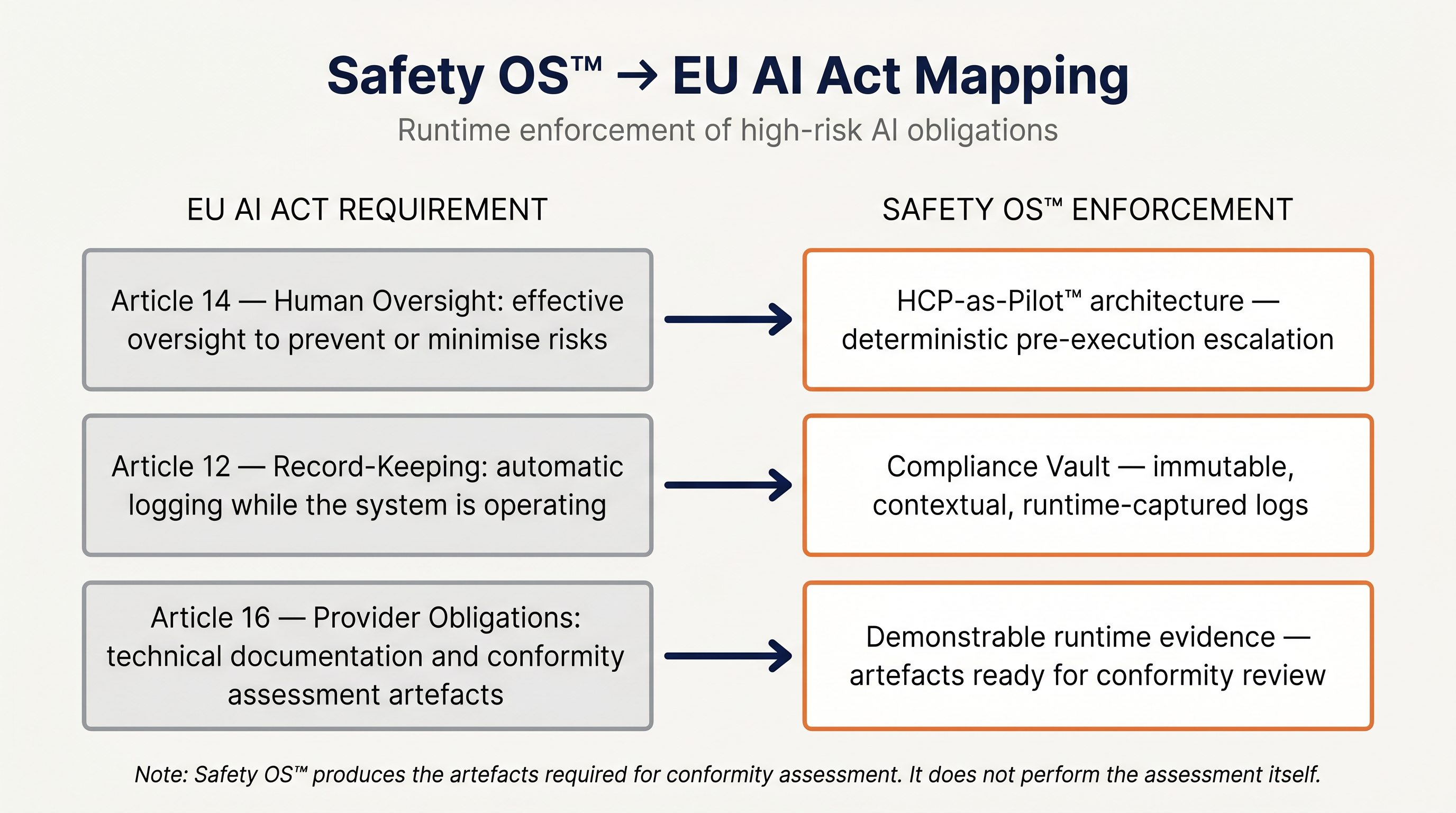
Required when AI influences clinical decisions under the EU AI Act. Safety OS™ bounds every AI component — from clinic, through discharge, into the home — without replacing existing systems.
Safety OS™ does not replace AI systems, EHRs, or workflows. It governs the execution path between AI output and patient-impacting action.
Safety OS™ is a runtime governance kernel that enforces authority constraints, consent gates, escalation logic, and immutable audit logging below the LLM layer. It is not a policy overlay. It is the execution environment in which AI operates — or does not operate — in private human environments.
Safety OS operationalises the governance architecture described in the Physician-as-Pilot Framework.
The framework defines how clinical authority, escalation logic, and audit traceability must be enforced when AI systems operate in private care environments.
We are defining the reference architecture for authority-bound AI in private environments. The operational template future regulation will formalize.
Core Principles
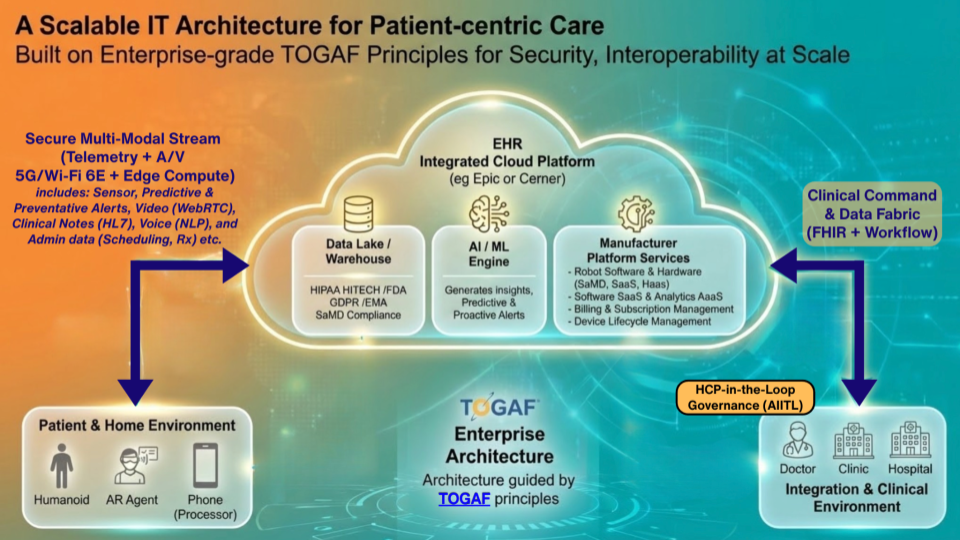
Physician-in-the-Loop (AIITL): Clinicians are pilots, not passengers.
Clinical Boundaries: Every behavior maps to defined protocols.
Transparency: All actions logged with timestamped audit trails.
Risk Detection: Real-time monitoring with fail-safe controls.
Privacy-First: HIPAA-compliant data handling with explicit consent.
Governance Foundations
Rooted in healthcare quality, risk management, and interoperability standards.
How Safety OS Works in Practice
The Safety OS is a regulatory-grade governance layer designed to ensure that all AI-mediated actions in home and humanoid care systems remain policy-constrained, auditable, and under explicit human oversight (Physician-as-Pilot). The system does not replace clinicians and does not perform autonomous medical decision-making.
Clinical Integration
Integrates with EHR systems and care team workflows. Complements existing processes.
Authority Is a System Variable — Not a Policy Statement
In Safety OS™, authority state is tracked at runtime. Every interaction records who holds decision authority, whether consent gates are active, and what escalation pathways are available. This is not documented in a PDF. It is enforced in the system.
The Irreversibility Mechanism
Investors ask: "Why can't OpenAI or Apple just add logging and copy this?"
The answer is structural, not narrative. Safety OS enforces four mechanisms that cannot be retrofitted onto an LLM:
1.Authority as a state variable — tracked at runtime, not declared in documentation
2.Deterministic boundary enforcement at runtime — not probabilistic, not prompt-based
3.Escalation-gated execution — no action proceeds without verified authority chain
4.Non-delegable human authority model — the system cannot grant itself permission
The moat is not audit logs. It is authority-constrained execution enforced below the LLM layer.
Chain of Custody
Event hashed locally at Edge Node
Hash validated server-side
Stored in WORM-compliant vault
Exportable for regulatory review
Why This Cannot Be Solved With Logging Alone
Most AI companies add safety as a policy layer after deployment. Safety OS enforces it as an execution constraint before any output is generated.
Capability
LLM-Only System (ChatGPT + logging)
Safety OS™ Kernel-Level Authority
Boundary enforcement
Probabilistic (prompt-based)
Deterministic (runtime-enforced)
Authority tracking
Not tracked
State variable per interaction
Consent enforcement
Terms of service (static)
Gated per session (dynamic)
Escalation logic
"Contact support"
Structured handoff with authority transfer
Audit trail
Application-level logs
WORM-compliant, hash-chained, exportable
Self-permission
Model can override own constraints
Architecturally impossible
Kill switch
Manual shutdown
Verified active per session
Post-hoc policy overlays are insufficient. Governance must be enforced at the execution layer — before any output is generated.
Benefits Across the Care Ecosystem
For Patients & Families
Predictable and transparent support
Safety with dignity
Consistent escalation paths to human caregivers
For Clinicians & Care Teams
Continuous visibility into support activities
Risk markers and trend insights
Enhanced capacity without unsafe autonomy
For Health Systems & Sponsors
Governance-aligned innovation pathway
Documented audit trails for compliance
Scalable model built on supervised action and oversight
Partner With Us
Dialogue with clinicians, health systems, and research institutions committed to safe AI support.